HR Reporting and Analytics in 2026: How to Turn Workforce Data Into Action
Quick Summary
- HR teams are not lacking data in 2026 — they are lacking clarity. Most collect workforce data across multiple systems but few translate it into decisions that improve operations.
- Effective HR analytics requires moving beyond operational reporting into trend identification, pattern recognition, and predictive workforce planning.
- Organizations that combine automated attendance tracking with centralized analytics report up to a 50% reduction in absenteeism.
HR analytics has evolved from a compliance function into a strategic lever that directly impacts productivity, labor costs, and workforce stability. The organizations that harness it effectively gain a measurable competitive advantage. The rest continue reacting to problems after they have already disrupted operations.
Why HR Analytics Matters More Than Ever
Without analytics, HR teams operate reactively — reviewing attendance records after absences have already disrupted shifts, auditing overtime after costs have already exceeded budgets, and investigating turnover after key employees have already left. With analytics, they operate with precision and foresight.
Identify absenteeism patterns early
See trends in attendance behavior weeks before they become chronic problems requiring disciplinary action.
Reduce overtime proactively
Align staffing with demand before gaps appear — rather than filling them with expensive unplanned overtime.
Improve employee performance
Connect attendance, engagement, and performance data to understand what actually drives workforce productivity.
Support labor law compliance
Maintain accurate, audit-ready records automatically — reducing the risk of wage and hour violations.
This is especially critical in environments requiring workforce management for manufacturing, where staffing gaps directly impact production output and revenue — and where the cost of a missed shift compounds across an entire line.
What Is HR Reporting and Analytics?
HR analytics is the process of collecting, analyzing, and interpreting workforce data to improve business outcomes. Reporting is the structured presentation of that data in dashboards and summaries that leaders can act on. Together, they transform raw workforce information into operational intelligence.
There are four levels of HR analytics — and most organizations never progress past the first:
- Operational — Tracks day-to-day workforce activity like attendance, hours worked, and call-offs. Necessary but not sufficient for strategic decision-making.
- Advanced — Identifies trends and correlations across data sets — connecting absenteeism patterns to scheduling gaps, or overtime spikes to specific managers or shifts.
- Strategic — Aligns workforce metrics with business goals — translating HR data into impact on revenue, labor cost, and operational efficiency.
- Predictive — Forecasts future workforce behavior and risks — enabling HR to intervene before problems occur rather than responding after they do.
Most organizations never move beyond operational reporting. That is where inefficiencies persist — and where the gap between reactive and proactive HR management widens every year.
How HR Analytics Drives Real Business Impact
When implemented correctly, HR analytics becomes a revenue and cost-control lever, not just a reporting function. The impact shows up across five measurable dimensions:
Reduced absenteeism
Identify patterns in attendance behavior and intervene early — before individual incidents escalate into chronic problems. See how to calculate and interpret your absenteeism data.
Lower labor costs
Minimize unnecessary overtime by aligning staffing with real demand. See our overtime management playbook for the framework that makes analytics actionable.
Improved scheduling
Match staffing levels to actual operational demand in real time, reducing both overstaffing waste and understaffing that triggers expensive gap-filling measures.
Higher productivity
Understand what workforce behaviors and conditions actually drive output — and use that data to replicate high-performance patterns across teams and locations.
Better retention
Address disengagement signals before they become voluntary departures. The cost of replacing an hourly employee consistently exceeds the cost of retention programs that act on early warning data.
How to Use HR Reporting and Analytics Effectively
Analytics without a structured approach produces noise, not insight. The following five steps give organizations a practical framework for building HR analytics that drives decisions rather than just dashboards.
1. Define Stakeholder Priorities First
HR analytics must align with what the business actually needs to solve. That requires understanding — in specific terms — what executives, operations leaders, and front-line managers are trying to improve or prevent.
Common stakeholder priorities include:
- Reducing absenteeism and no-call no-shows that disrupt shift coverage
- Improving shift fill rates without relying on unplanned overtime
- Lowering total overtime costs as a percentage of labor spend
- Increasing workforce accountability across managers and locations
Without clear priorities anchored to business outcomes, analytics teams produce reports that get reviewed once and filed. Connecting every metric to a specific decision someone needs to make is what separates useful analytics from noise. This is a key element of solving common HR problems at scale.
2. Centralize Workforce Data
Most organizations store HR data across payroll, scheduling, timekeeping, and performance systems that do not communicate with each other. This fragmentation creates blind spots — managers see attendance data in one system, overtime in another, and performance in a third, with no way to connect them.
- Single source of truth — One system holds all workforce data — accessible in real time by every stakeholder who needs it.
- Faster decision-making — No time lost reconciling data from separate systems before a manager can act on a scheduling gap.
- Full cross-departmental visibility — Operations, HR, and payroll share the same view — eliminating the version conflicts that delay decisions.
This is critical for organizations that must maintain delivery schedules and cannot afford the operational delays that come from disconnected data systems. For healthcare environments, centralized data is also a patient safety issue — not just an efficiency one.
3. Build Analytical Capabilities — Not Just Tools
Purchasing an analytics platform does not automatically create analytical capability. Organizations must develop the ability to interpret workforce data and act on it — which requires both the right tools and the right processes.
- Use real-time analytics instead of historical reports — decisions made on last month’s data are already late
- Train managers to recognize workforce behavior patterns, not just read numbers
- Connect HR data to operational outcomes so every metric links to a decision someone can make
- Eliminate ‘black box’ reporting where data appears without context or recommended action
The attendance tracking platforms that provide the most value are those that pair data with recommended actions — surfacing insights in the context where managers already work, rather than requiring them to log into a separate reporting tool.
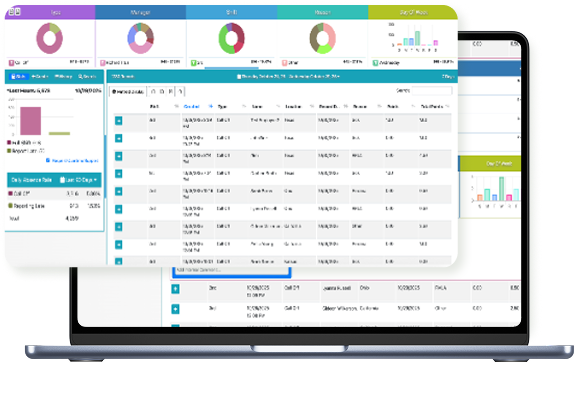
4. Use Dashboards for Real-Time Visibility
Dashboards translate data into actionable intelligence. Instead of reviewing static weekly reports after issues have already occurred, leaders can monitor workforce performance as it happens — and intervene before disruptions affect operations.
- Attendance trends — See which employees, departments, or shifts are showing early patterns of chronic absenteeism before they reach policy thresholds.
- Overtime hours in real time — Monitor labor spend against budget as the week progresses — not after payroll closes and the overage is locked in.
- Shift coverage gaps — Identify open shifts and understaffed periods while there is still time to fill them without triggering costly overtime.
- Employee availability — Know which employees are available, which are approaching overtime limits, and which have outstanding compliance issues — all in one view.
Effective shift management depends entirely on the quality and timeliness of the visibility underneath it. A dashboard that updates in real time is a fundamentally different operational tool than one that shows yesterday’s data.
5. Continuously Optimize — Analytics Is Not a One-Time Initiative
Organizations that implement HR analytics and treat it as a completed project rarely see sustained improvement. Workforce conditions change, business priorities shift, and the data patterns that mattered in Q1 may look different by Q3.
A continuous improvement approach includes:
- Quarterly reviews of workforce KPIs against business outcomes — not just internal benchmarks
- Policy updates driven by what the data reveals, not what was assumed when the policy was written
- Data quality audits to catch integration failures before they corrupt decision-making
- Expansion of analytics scope as organizational capability matures
Key HR Metrics That Matter in 2026
Not all data is valuable. Tracking too many metrics creates analysis paralysis and dilutes focus. High-performing organizations concentrate on a core set of KPIs directly tied to business outcomes.
Absenteeism rate
The primary indicator of workforce reliability. Tracked by employee, team, shift, and location to identify where intervention is most needed.
Overtime hours and cost
Signals scheduling inefficiency. Rising overtime as a percentage of total labor spend indicates a demand forecasting or policy enforcement problem.
Revenue per employee
Connects workforce decisions to business outcomes — helping leadership understand the productivity impact of attendance and staffing choices.
Time to fill open shifts
Measures scheduling agility. Long fill times drive overtime and indicate gaps in cross-training or available staff bench depth.
Turnover rate by department
Signals workforce stability problems. High turnover in specific teams often correlates with scheduling practices, manager behavior, or attendance policy inconsistency.
Schedule adherence rate
Tracks whether employees work the shifts they are scheduled for. Low adherence is a leading indicator of both absenteeism trends and engagement decline.
For a deeper look at the mechanics of measuring workforce reliability, see our guide on how to calculate absenteeism and why the formula alone is not enough to drive improvement.
The Role of Automation in HR Analytics
Manual reporting limits the value of HR analytics in two ways: it introduces lag between when something happens and when a decision-maker sees it, and it introduces human error into the data that decisions are based on. Automation eliminates both problems.
- Instant attendance and call-off tracking — Every absence, late arrival, and shift change is recorded the moment it occurs — no manual entry, no delay, no missed events.
- Workforce gaps identified before they impact operations — Automated systems flag coverage shortfalls as soon as they appear on the schedule — while there is still time to fill them without overtime.
- Consistent policy enforcement — Attendance and scheduling rules are applied automatically — removing the manager subjectivity that creates both compliance risk and employee grievances.
- Seamless payroll and operations integration — Workforce data flows directly into payroll, eliminating the reconciliation process that delays reporting and introduces calculation errors.
Productivity Pilot powers this entire analytics layer.
Productivity Pilot centralizes attendance tracking, call-off communication, policy enforcement, and workforce communication into a single platform — giving HR and operations teams the real-time visibility they need to act on data instantly rather than reacting after issues occur. Organizations using Productivity Pilot gain workforce analytics that is always current, always accurate, and always connected to the decisions that matter.
See Productivity Pilot’s analytics in action — schedule a demo
Best Practices for Building a Data-Driven HR Organization
The following practices separate organizations that use analytics to drive decisions from those that use it to produce reports no one reads.
Encourage data-driven decisions at every level
Analytics should inform front-line managers’ daily scheduling choices, not just quarterly leadership reviews.
Limit KPI tracking to high-impact metrics
Five meaningful metrics drive more action than twenty metrics that dilute focus and overwhelm reporting consumers.
Invest in scalable, real-time analytics tools
Systems that require manual exports or weekly report runs cannot support the decision speed that modern operations demand.
Ensure compliance with data privacy standards
Workforce data carries legal obligations. Review your data privacy commitments and ensure analytics systems meet applicable requirements.
Continuously refine based on what the data reveals
Treat every insight as an input into the next iteration of your HR strategy — not a one-time finding that gets addressed and filed.
Organizations that adopt these practices transition HR from an administrative cost center to a strategic driver of business performance. The shift is not primarily technological — it is cultural. Data-driven HR requires leadership commitment to using evidence over intuition when the two conflict. See how high-performing HR teams approach this in our guide to solving common HR problems with workforce automation.
Conclusion: Data Without Action Is Useless
HR teams are sitting on massive amounts of workforce data. The competitive advantage does not come from collecting more of it — it comes from turning what you already have into decisions that improve attendance, reduce labor costs, and stabilize operations.
In 2026, the organizations that win are those that use analytics to anticipate problems rather than respond to them. Whether the goal is reducing tardiness and absenteeism, controlling overtime costs, or improving overall attendance, the path to measurable improvement runs through better visibility and faster action.
Ready to Build a Data-Driven Workforce Strategy?
Productivity Pilot gives HR and operations teams the real-time analytics, automated tracking, and policy enforcement tools to turn workforce data into measurable business outcomes — starting within 60 days of implementation.
Schedule a 20-minute demo · See the Productivity Pilot Difference